
Gout Isn’t Just About Uric Acid: What Most Patients Don’t Know

Gout is often described as a “uric acid problem,” and while uric acid plays an important role, that explanation alone is incomplete. Many people are surprised to learn that gout is not just about a number on a blood test—and that misunderstanding often delays proper care.
To truly understand gout, it helps to look beyond lab values and focus on patterns, triggers, and inflammation.
Why Gout Is Commonly Misunderstood
Most people associate gout with:
- High uric acid levels
- Sudden joint pain
- Dietary triggers
- Big toe involvement
While all of these can be part of gout, they do not tell the full story. Gout is an inflammatory arthritis, not just a metabolic issue.
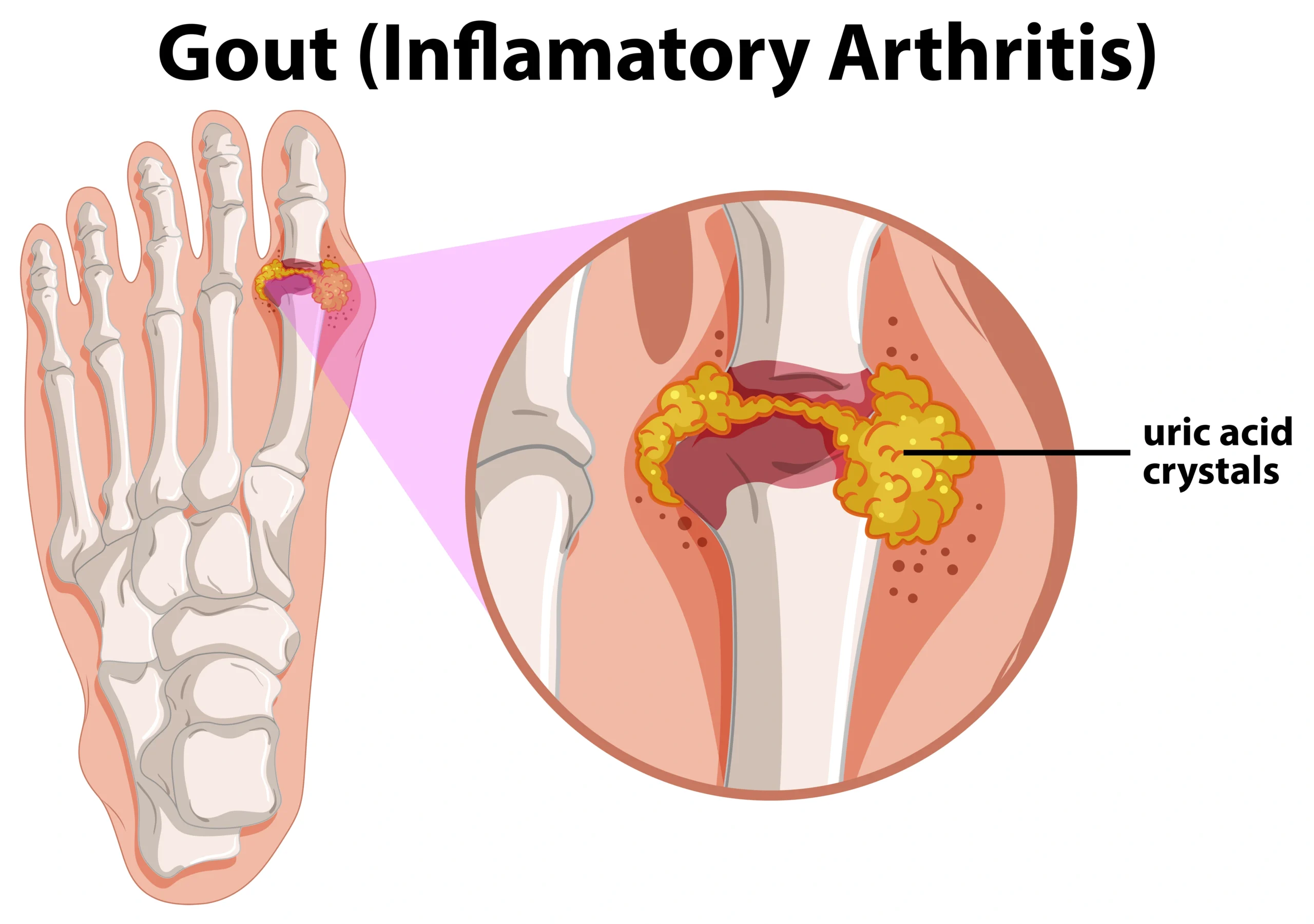
What Actually Causes Gout
Gout occurs when uric acid crystals deposit in joints or surrounding tissues, triggering an intense inflammatory response.
However, important nuances are often missed:
- Uric acid levels can fluctuate
- Crystals may already be present even when blood levels look normal
- Inflammation is driven by the immune system’s response to crystals
- Flares can occur long after uric acid levels initially rise
This explains why gout behaves unpredictably for many people.
Can Gout Occur With Normal Uric Acid Levels?
Yes—and this surprises many patients.
During an acute gout flare:
- Uric acid levels may temporarily drop
- Blood tests may appear normal
- The immune response, not the number, drives pain
This is why relying on a single uric acid reading during a flare can be misleading.
Why Gout Pain Feels So Sudden and Severe
Gout attacks are often described as intense and abrupt.
This happens because:
- Uric acid crystals sharply activate inflammation
- The immune response is rapid and aggressive
- Joints become extremely sensitive to pressure
- Pain can escalate within hours
The severity is linked more to inflammation than to uric acid level alone.

Common Triggers Beyond Diet
Diet is often blamed for gout, but it is only one part of the picture.
Other triggers include:
- Dehydration
- Sudden illness or infection
- Stress or physical strain
- Certain medications
- Rapid changes in uric acid levels
- Weight fluctuations
Understanding triggers helps reduce recurrence and confusion.
Which Joints Can Be Affected
Although the big toe is classic, gout is not limited to one joint.
It can affect:
- Ankles
- Knees
- Feet
- Wrists
- Fingers
- Elbows
Over time, repeated flares may involve multiple joints.
Gout Is More Than “Occasional Attacks”
Untreated or poorly controlled gout can evolve.
Possible long-term effects include:
- Increasing frequency of flares
- Joint damage over time
- Chronic joint pain between attacks
- Tophi (crystal deposits under the skin)
- Reduced joint mobility
This progression highlights why gout should be taken seriously.
Why Gout Is Often Diagnosed Late
Gout is sometimes delayed in diagnosis because:
- Early flares may resolve on their own
- Symptoms mimic injury or infection
- Uric acid levels appear normal
- Attacks may be infrequent initially
As a result, people may go years without clarity.
When to Consider Specialist Input
Rheumatology guidance may be helpful if:
- Joint pain is sudden and severe
- Attacks recur over time
- More than one joint becomes involved
- Pain does not fully resolve
- There is uncertainty about diagnosis
- Uric acid levels fluctuate
Specialist evaluation focuses on patterns and progression, not just lab values.
What Helps Bring Clarity
A structured approach often includes:
- Reviewing flare history and frequency
- Identifying non-diet triggers
- Understanding inflammation patterns
- Evaluating joint involvement over time
- Interpreting uric acid levels in context
This helps move from confusion to informed decision-making.
The Takeaway
Gout is not just about uric acid.
It is an inflammatory arthritis shaped by immune response, triggers, and patterns over time.
Looking beyond a single blood test allows for better understanding—and better planning for the future.